The Science of Memory Transformation
Most traditional study methods rely on "passive review"—reading a text repeatedly until it feels familiar. However, research in cognitive psychology suggests that familiarity is a deceptive metric. True learning occurs when the brain is forced to retrieve information, not just recognize it. This phenomenon, known as the illusion of competence, is why re-reading is often a waste of time.
fastMEMORIZER is built upon proven psychological principles designed to optimize how your brain encodes and retrieves information. We utilize three core pillars: Active Recall, Desirable Difficulty, and Supra-grammatical Processing.
1. Active Recall: The "Retrieval Practice"
Active recall is a highly effective learning technique that involves testing yourself during the learning process. Instead of simply looking at the words, you challenge your brain to produce them from memory. This acts as a signal to the brain that the information is important and needs to be stored in long-term memory.
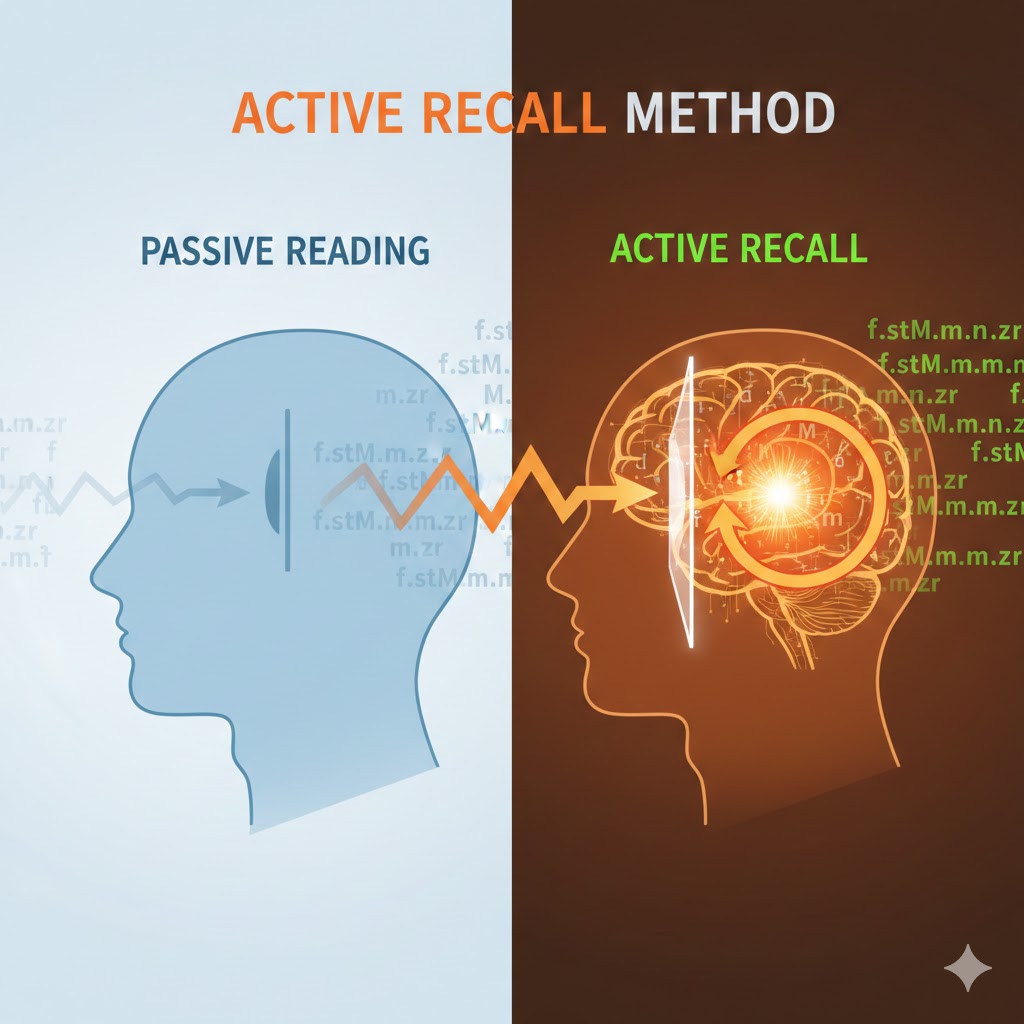
Visualization: How partial hiding of text triggers active retrieval pathways in the brain.
By using modes like First Letter or Cover, you are not just reading; you are "pulling" information out of your brain. Every time you successfully recall a hidden word, you strengthen the neural connections associated with that information, making it much harder to forget. This is the opposite of passive reading, which only strengthens recognition, not recall.
2. Supra-grammatical Processing: Mastering the "Typoglycemia"
A fascinating study from the University of Cambridge revealed a quirk of the human mind: our brains don't read every letter by itself, but the word as a whole. As long as the first and last letters are in the right place, the middle can be a total mess, and we can still read it with surprising ease. This cognitive phenomenon is called Typoglycemia.
"Aoccdrnig to a rscheearch at Cmabrigde Uinervtisy, it deosn't mttaer in waht oredr the ltteers in a wrod are, the olny iprmoatnt tihng is taht the frist and lsat ltteer be in the rghit pclae."
The Mix Inside mode leverages this ability to turn passive reading into active decoding. When you use this mode, you stop "skimming" and start actively engaging with the text. Your brain is forced to stop relying on recognition of the word's shape and must reconstruct the meaning by processing the internal letters. This significantly increases your cognitive engagement with the material, making the memory trace far more durable.
3. Desirable Difficulty & Cognitive Load
A concept introduced by psychologist Robert Bjork, desirable difficulty suggests that we learn best when the task is challenging enough to require significant effort, but not so hard that we give up. If studying is too easy, you are not forming strong memories. If it is too hard, you become overwhelmed.
fastMEMORIZER gives you total control over this difficulty. If a text is new, you might start with Mix Inside to get used to the word shapes without completely hiding them. Once you become more comfortable, you can switch to 1st Letter mode or increase the Intensity of hidden words. This progressive challenge ensures you are always in the "optimal learning zone."
Key Benefits of Our Method:
- Superior Long-term Retention: Information learned through effort stays with you longer.
- Reduced Study Time: 15 minutes of active recall is more effective than an hour of passive reading.
- Combat "The Forgetting Curve": By actively engaging with the text, you flatten the curve and keep information fresh.
- Increased Confidence: When you know you can recall the text under pressure, your performance anxiety decreases.
Why Context Matters
Our app does not just hide random words; it intelligently allows you to manipulate the text structure. By understanding phrases and sentence flow, fastMEMORIZER allows you to train your brain to recognize patterns and associations, which is crucial for remembering complex information.