|
Scale to Chords
|
 Tip:
Tip:|
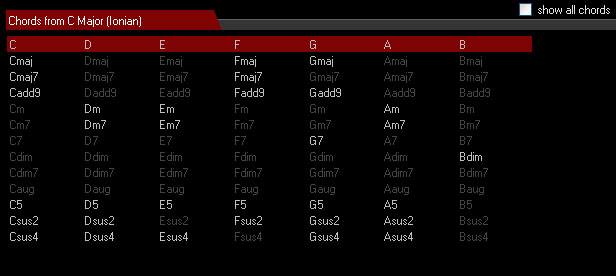
After selecting any chord from table click red Play button and that chord will be continuously
played with synth sound.The same can be done by double clicking any chord in table.(I bet that
you've always wanted someone who will hold Am or Cmaj forever while you are soloing over them
 ) ) |
 Tip:
Tip:|
Have you ever been confused with real meanings of music scales Modal theory?Theory states that
from each scale can be derived few more scales with same notes.More precise if a scale contains
7 notes then there is 7 different scales called Modes which shares same notes as main scale.So
from C major scale (containing C,D,E,F,G,A,B notes) we can obtain following seven modes:
C Major (Ionian) C,D,E,F,G,A,B
D Dorian D,E,F,G,A,B,C
E Phrygian E,F,G,A,B,C,D
F Lydian F,G,A,B,C,D,E
G Mixolydian G,A,B,C,D,E,F
A Aeolian (Natural minor) A,B,C,D,E,F,G
B Locrian B,C,D,E,F,G,A
As you can see all modes are the same,only difference is in starting note.Why then we think
about them as different scales?Yes it is confusing,but if you hear it in harmony context you will
hear clearly difference in sound and mood they produces.Here is where you can really benefit from
"Scale to chords" page.
If you load C major scale and click on highlighted Dm chord starting play-you will hear notes from
C major scale played over Dm chord.But! Notes will start playing from D instead of C and backing
harmony will be Dm and what you will hear will be D dorian mode indeed!
If you click on Em and start playing,scale will be played from E and backing chord will be Em,and
what are you hearing is E Phrygian!
Major scale and a few other scales are well known in music theory and for that reason its modes
have names.But other modes from other scales are usually named as Mode I ,Mode II, Mode III
...where I,II,III ...means that mode starts from 1st,2nd,3rd...degree of original scale
|